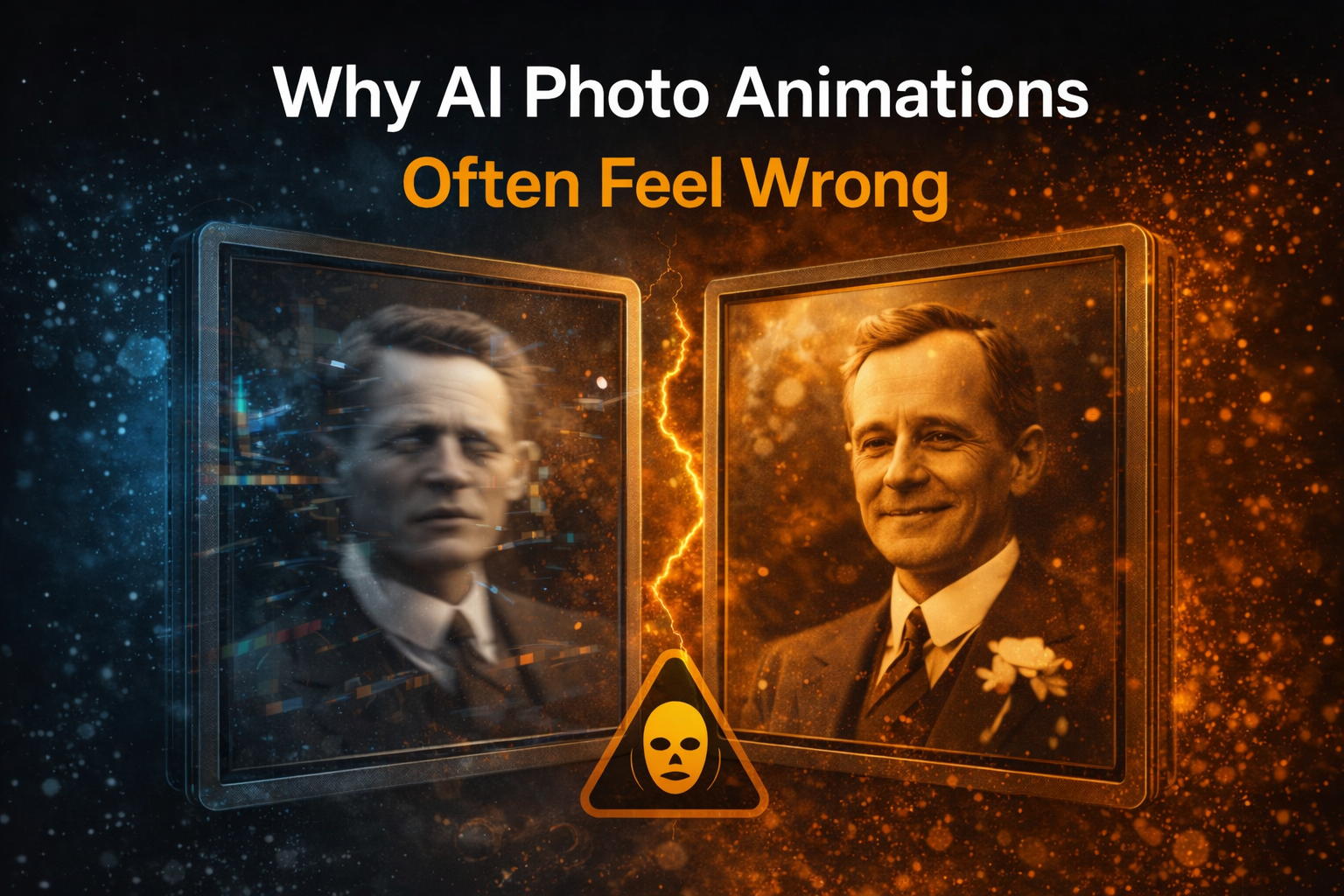
Why AI Photo Animations Often Feel Wrong
AI photo animation has reached a point where the technology itself is no longer the main limitation. Yet many people still describe the results as “strange,” “unnatural,” or simply “off.” This reaction is common — and understandable. But in most cases, the issue is not the AI model, the algorithm, or the tool. It’s the expectation placed on the result.
The Problem Isn’t That AI Can’t Animate Photos
Modern AI systems are very good at detecting faces, predicting subtle motion, and generating short video sequences from still images. From a technical perspective, the process works remarkably well. If you’re looking for a general explanation of how AI photo animation functions, it’s covered in detail in Animate Photos with AI: A Beginner’s Guide. The disconnect happens after the animation is generated — when people compare what they see to what they expected to feel.
Movement Is Not the Same as Life
One of the most common misconceptions is that more movement equals more realism. In reality: exaggerated motion often feels artificial visible expression can break emotional continuity subtle movement tends to feel more believable Human perception is extremely sensitive to faces. Even small deviations in timing or expression can trigger discomfort. This is not a failure of AI — it’s a limitation of human perception.
Why Expectations Are Often Unrealistic
Many expectations are shaped by: edited demo videos short social media clips cinematic portrayals of “bringing photos to life” These references suggest that a still image can suddenly behave like a real person. AI photo animation does not — and should not — aim for that. When people expect reconstruction instead of approximation, disappointment is almost guaranteed.
Old and Personal Photos Make the Effect Stronger
The emotional weight of a photo changes how results are perceived. With personal or historical images: viewers project memory and identity onto the face even small inaccuracies feel amplified emotional context outweighs technical accuracy This is especially noticeable with scanned or old photographs. Their behavior differs significantly from modern digital images, which is why we cover that topic separately in How to Animate Old Photos with AI.
When “More Control” Makes Things Worse
Another common assumption is that more settings lead to better outcomes. In practice: more controls increase inconsistency fine-tuning often exaggerates artifacts users overcorrect instead of observing This is why many results feel unstable or “overworked.” The problem isn’t lack of power — it’s too much intervention.
The Uncanny Line Is Very Thin
There is a narrow zone where AI photo animation feels acceptable. On one side: no movement → lifeless On the other: too much movement → uncanny The goal is not to cross that line. The goal is to hover just below it. This balance is difficult — not because AI is weak, but because human perception is unforgiving.
Why Tool Choice Still Matters (But Not the Way People Think)
People often ask which tool is “best.” That question misses the point. The more relevant question is: Which tool aligns with the kind of result I actually want? Tools designed for personal memory use tend to favor restrained motion and predictable output. Platforms such as LiveMemo.app focus on that balance, prioritizing emotional consistency over expressive effects. The difference is not technological superiority — it’s philosophy.
Accepting What AI Photo Animation Is — and Isn’t
AI photo animation does not bring people back. It does not recreate moments. It does not recover the past. What it can do is offer a gentle sense of presence, when used with restraint and realistic expectations. When results feel wrong, it’s often because the goal was wrong to begin with.
Final Thoughts
AI photo animations feel wrong not because the technology fails — but because we often ask it to do something it was never meant to do. When expectations shift from “make it real” to “make it subtle,” the experience changes entirely. The technology hasn’t fallen short. Our assumptions have.
About this article
This article was prepared by the LiveMemo team based on hands-on work with AI photo animation tools and real user reactions, focusing on perception, emotional response, and the limits of realism rather than technical specifications.
Ready to Bring Your Photos to Life?
Transform your cherished memories into living videos with LiveMemo's AI technology.
Try LiveMemo Free