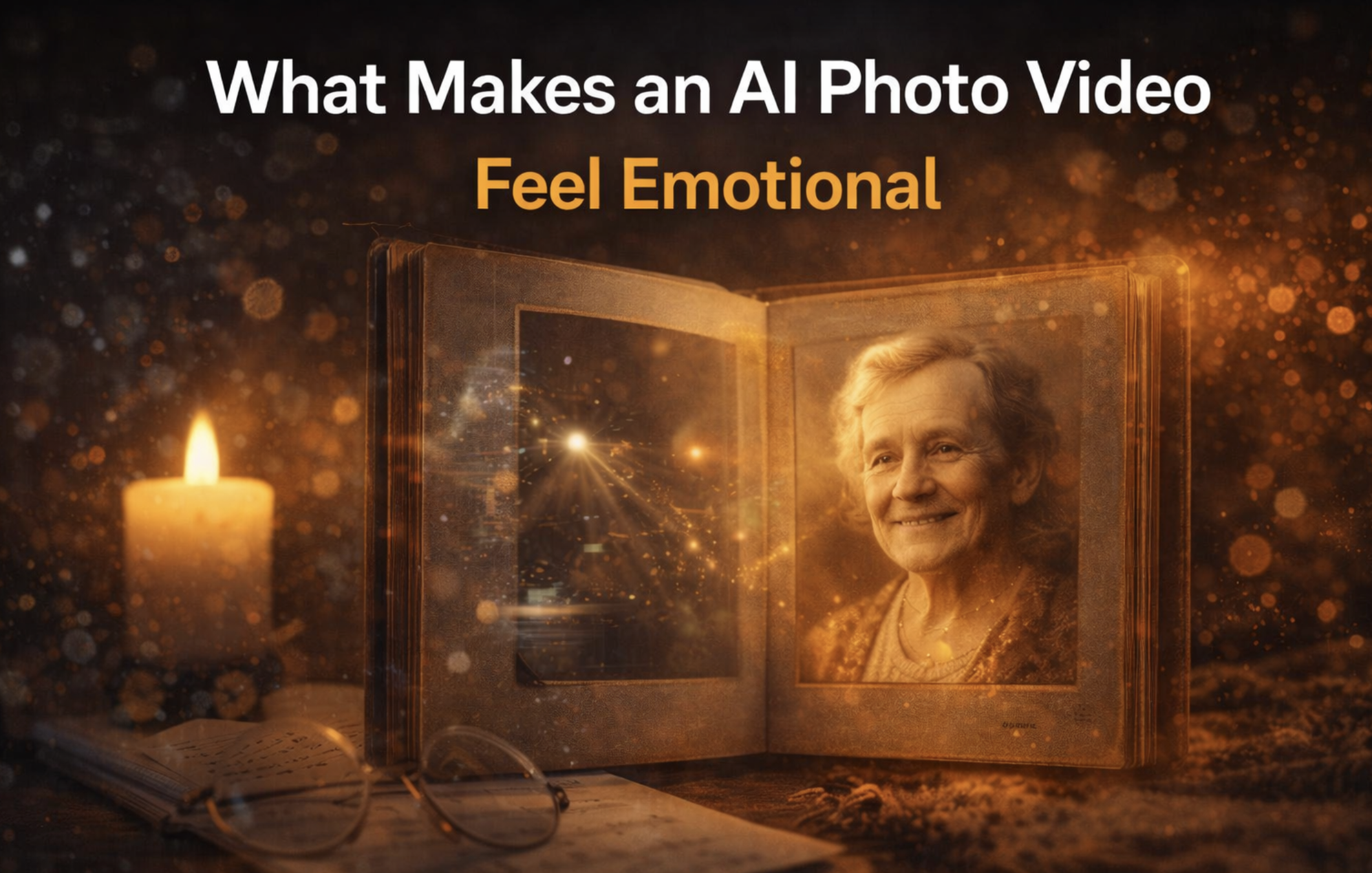
What Makes an AI Photo Video Feel Emotional
People often describe AI photo videos as “emotional,” but the word is used loosely. Some videos genuinely create a sense of presence. Others feel technically impressive — yet emotionally empty. The difference rarely comes from the technology itself. It comes from how emotion is perceived, and what people expect the animation to deliver.
Emotion Is Not Created by Movement
A common assumption is that motion creates emotion. In practice, the opposite is often true: strong movement draws attention to the animation exaggerated expressions break immersion visible effort replaces emotional response Emotion emerges when movement is subtle enough to fade into the background.
Why Subtlety Feels More Emotional Than Expression
Human memory does not replay moments with clarity. It recalls fragments, pauses, and impressions. When an AI animation mirrors that restraint: the viewer fills in the gaps the face feels familiar rather than animated emotion is projected, not forced This is why minimal changes — a slight shift of gaze or breath — often feel more powerful than a visible smile.
Context Matters More Than the Animation Itself
Emotion does not exist in isolation. The same animated photo can feel: neutral in one context deeply personal in another Personal history, memory, and expectation shape the reaction far more than animation quality. This is also why personal and historical photos behave differently — a topic we explore in How to Animate Old Photos with AI.
What Never Creates Emotional Impact
Some elements consistently fail to create emotional depth. They include: dramatic facial expressions visible animation artifacts over-polished motion effects that draw attention to themselves These elements make the video noticeable — but not meaningful.
Why Music and Effects Rarely Help
Music is often added in an attempt to “enhance” emotion. But when emotion is imposed externally: the image loses authenticity the response feels guided subtlety disappears Silence or minimal sound often preserves emotional honesty better than background music.
Expectation Is the Hidden Variable
Emotion breaks down when people expect AI to: recreate a person restore a moment simulate consciousness AI photo animation does none of these things. When expectations shift toward suggestion instead of reconstruction, emotional response improves dramatically. This is closely tied to why many AI photo animations feel wrong in the first place — explored in Why AI Photo Animations Often Feel Wrong.
Tool Choice Influences Emotional Consistency
Tools designed for experimentation often prioritize visible motion. Tools built for memory-oriented use focus on: restraint predictability emotional continuity Platforms like LiveMemo.app reflect this approach by limiting expression in favor of subtle presence. The goal is not to impress — but to avoid breaking the emotional connection.
Emotion Emerges When the Tool Gets Out of the Way
The most emotionally effective AI photo videos share one trait: You stop noticing the animation. When attention shifts away from the technology, emotion has space to appear. This is not a technical achievement. It’s a perceptual one.
Final Thoughts
AI photo videos feel emotional not because they simulate life — but because they leave room for memory. What never works is trying to replace what the photo already represents. What sometimes works is quietly supporting it. Emotion is not generated. It is allowed.
About this article
This article was prepared by the LiveMemo team based on observation of real user reactions to AI photo videos, focusing on emotional perception, restraint, and the role of expectation rather than technical capability.
Ready to Bring Your Photos to Life?
Transform your cherished memories into living videos with LiveMemo's AI technology.
Try LiveMemo Free