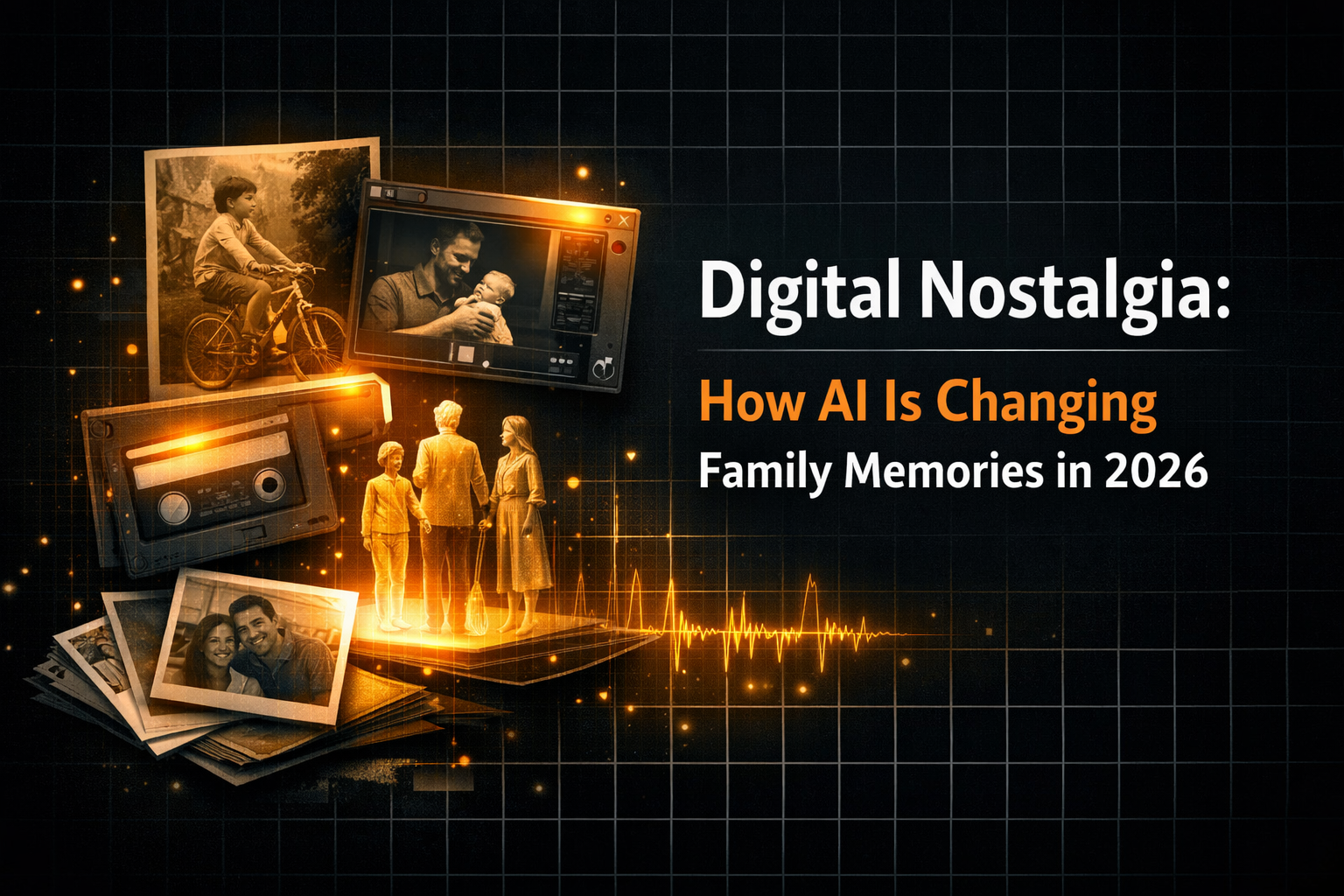
Digital Nostalgia: How AI Is Changing Family Memories in 2026
Most conversations about artificial intelligence revolve around work, automation, or productivity. But in 2026, one of the most unexpected cultural shifts has emerged not in the office, but at home. AI is quietly reshaping how families remember, archive, and emotionally experience their own history. The phenomenon has a name: digital nostalgia. Digital nostalgia refers to the way technology — especially AI — amplifies, reconstructs, animates, and reinterprets memories. It sits at the intersection of psychology, family identity, legacy, and storytelling. It changes not only what is remembered, but how it is remembered, who gets to remember, and for how long. This shift marks an inflection point: the era where memory becomes partially engineered.
Why Nostalgia Became Digital
Nostalgia is not a modern invention — it’s one of the oldest emotional systems in human psychology. But the tools of nostalgia have changed dramatically over the last century. Before 1900: memory was oral — stories, myths, family lore. 1900–1980: memory became visual — photographs and film. 1980–2010: memory became digital — cameras and storage. 2010–2023: memory became social — shared across platforms. 2023–2026: memory becomes computed — reconstructed and reanimated by AI. This is more than technological progress. It’s a cultural evolution in how families understand themselves.
The Psychology of Nostalgia (Why Families Care So Much About Remembering)
Nostalgia reinforces identity, belonging, and intergenerational connection. Psychologists observe that nostalgia peaks during three life phases: → childhood (memory construction) → early adulthood (identity formation) → late adulthood (legacy & reflection) Parents and grandparents sit at the final peak — where memory becomes not just sentimental, but meaningful. For a deeper look at how families preserve legacy and meaning, see: → How to Preserve Family Memories (2026 Guide)
AI and the New Emotional Memory Stack
AI adds new capabilities across the “memory stack”: ✔ restoration ✔ reconstruction ✔ animation ✔ narrative generation ✔ legacy packaging This shifts memory from static → dynamic.
Digital Nostalgia Meets Emotional Gifting
Digital nostalgia pairs naturally with emotional gifting — a trend that surged from 2023–2026. Emotional gifts work because they activate identity, belonging, and recognition. This is especially true for parents and grandparents. We explored this dynamic in depth here: → Best Emotional Gifts for Parents and Grandparents (2026 Guide) Digital nostalgia makes these gifts more personal, more emotional, and more enduring.
The Intergenerational Shift
Before AI, most family history disappeared within two generations. Digital nostalgia increases the probability of survival — not as dusty albums, but as vivid emotional artifacts. Grandparents → Parents → Children → Future
Why This Is Happening Now (Timing Matters)
Three macro-forces converged: ✔ demographic timing ✔ photo saturation ✔ emotional economics The rise of digital nostalgia is not accidental — it is inevitable.
From Nostalgia to Legacy
Grandparents think less about nostalgia and more about continuity: → “What remains?” → “What survives?” → “How will they remember?” Digital nostalgia offers a new answer.
Memory as a Designed System (2026–2030 Forecast)
Expect family memory to become: ✔ curated ✔ interactive ✔ archived ✔ gifted ✔ searchable ✔ modular ✔ and preserved across generations Memory is becoming productized, emotional, and intentional. Conclusion AI did not replace memory — it resurrected it. Digital nostalgia is the first major emotional use case for AI — and its impact is cultural, not technical. Families are not asking AI to invent new memories. They are asking it to honor the ones that already exist.
Tools like LiveMemo help families animate old photos into small emotional moments — micro memories that feel alive and are easy to preserve, share, and gift.
Ready to Bring Your Photos to Life?
Transform your cherished memories into living videos with LiveMemo's AI technology.
Try LiveMemo Free