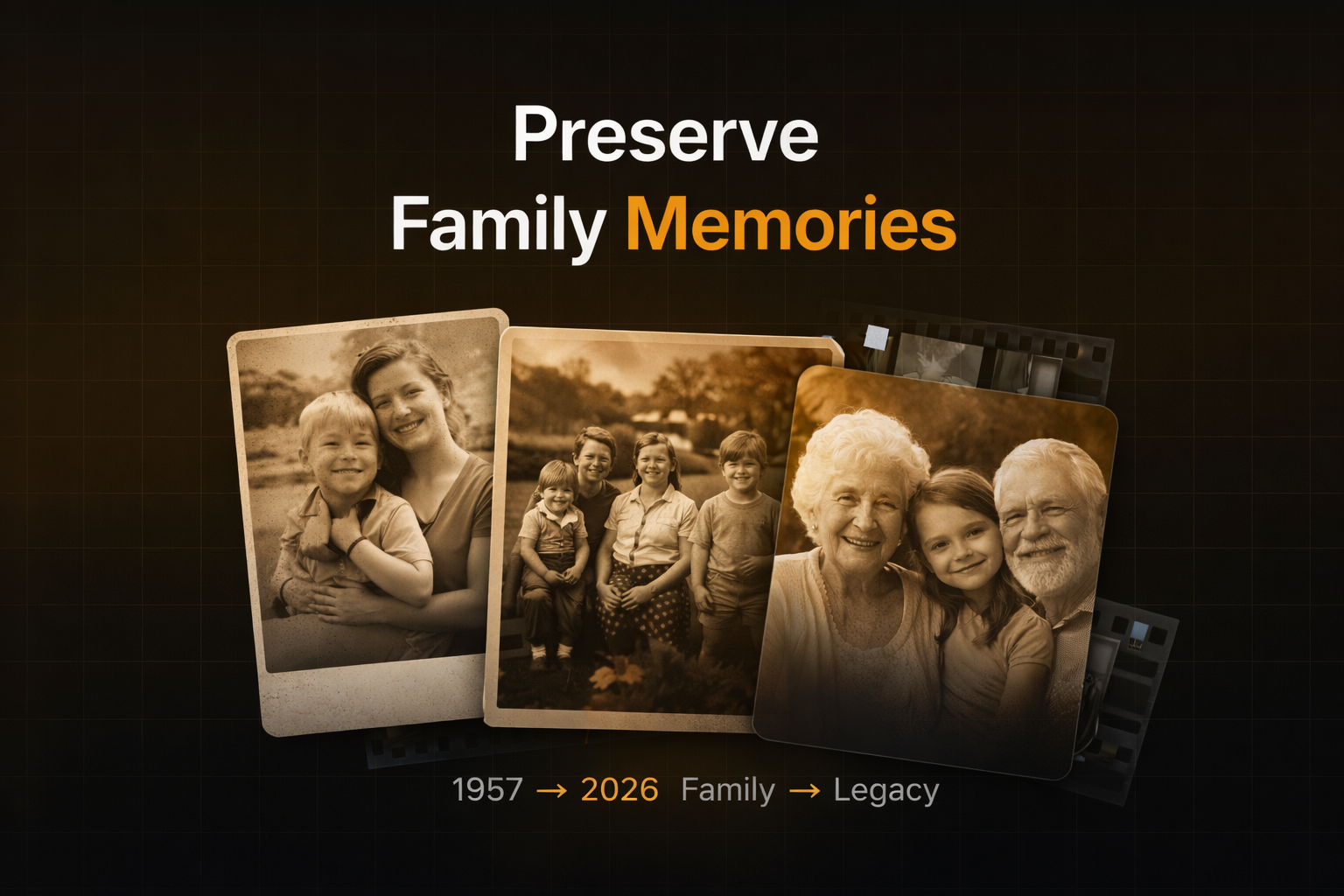
How to Preserve Family Memories (2026 Guide)
Family memories are some of the most fragile yet valuable things we carry through life. They remind us where we came from, who we loved, what shaped us, and how time quietly transforms everything. The interesting thing about family memories is that they don’t just belong to individuals — they belong to generations. Family memories matter because they help us belong, understand ourselves, and carry love across time. And yet, despite their importance, memories often fade faster than we expect — not because they weren’t meaningful, but because nobody captured them in time.
Why Family Memories Matter
Psychologists describe memory as a kind of emotional glue. It binds relationships, creates identity, and gives context to our lives. Family memories reinforce belonging, provide continuity across generations, and help children form identity and resilience.
The Problem — Memories Fade Faster Than We Think
Most families don’t lose memories suddenly — they lose them gradually.
Physical photos decay
Printed photos are vulnerable to fading, moisture, bending, and loss.
Digital chaos is overwhelming
The average person stores tens of thousands of photos on a phone, but very few are labeled, sorted, or reviewed.
Context disappears first
A photo without a story becomes just an image. Without context, memories flatten and lose emotional weight.
The “silent generation” effect
Parents and grandparents often hold the richest stories, but rarely document them. When they pass, stories disappear with them.
Traditional Ways Families Preserved Memories
Before digital technology, families relied on photo albums, scrapbooks, diaries, memory boxes, and home video tapes. These formats are sentimental and tangible, but vulnerable to time and damage.
The Digital Shift — Storage vs Preservation
In the 2010s and 2020s, memory storage moved to the cloud: shared folders, group chats, and private albums. But storing files is not the same as preserving memories. Storage asks: “Where do I put this so I don’t lose it?” Preservation asks: “How do I make sure this memory is understood and felt?”
Why Emotion Matters in Memory Preservation
Family memories are emotional. Meaning requires storytelling, not just data. A labeled JPEG folder may be organized, but without emotion and continuity it lacks legacy.
AI and the New Generation of Family Memory Tools
From 2023 to 2026, AI introduced new ways to preserve memories: restoring old photos, colorizing black-and-white images, removing scratches, upscaling low-resolution scans, and even generating short emotional videos from a single family photo. These micro-emotional videos are not cinematic — they are intimate. They capture a moment of time in a 5–10 second nostalgic hit.
Ideas to Preserve Family Memories (Actionable and Modern)
Childhood timelines
Collect photos from infancy to adulthood and arrange them chronologically for a birthday, graduation, or tribute.
Tribute videos for parents or grandparents
Simple emotional tributes become family keepsakes for decades.
Memory gifts for holidays and birthdays
Mother’s Day, Father’s Day, anniversaries, and Christmas are ideal for memory gifting.
Digital family archive for future children
Even if children aren’t born yet, archiving family history becomes a future gift.
Family storytelling sessions
Record elders telling stories about childhood, migration, jobs, and traditions.
Baby-to-adult transformations
These formats trigger nostalgia and highlight how quickly time moves.
Micro emotional videos
Short emotional videos generated from a single photo are becoming a new family nostalgia format. Tools like LiveMemo allow families to create these in seconds without editing skills.
Organizing Memories So They Don’t Get Lost
Archivists recommend digitizing prints, labeling by year and people, grouping by events, adding short stories, and recording elders while they’re alive. Future generations need both photos and context.
Family Memories as Gifts (and Why They Convert Emotionally)
Memory gifts combine identity, nostalgia, and time — three of the most emotionally powerful ingredients in gifting.
Birthday
Nostalgic videos make birthdays personal.
Mother’s Day
Memory gifting is one of the strongest emotional gift categories for mothers.
Father’s Day
Fathers emotionally respond to identity and legacy.
Christmas
Family nostalgia and Christmas blend naturally.
Anniversaries
Anniversaries are about time — nostalgia amplifies that.
Grandparents Day
Grandparents feel meaning through legacy and family continuity.
Retirement
Retirement tributes connect work identity with family identity.
Short Emotional Videos — The New Nostalgia Format
Younger generations prefer short emotional videos over long cinematic slideshows. They are fast to watch, trigger nostalgia instantly, and work across generations. Tools like LiveMemo now allow families to generate emotional micro-videos from a single photo in seconds.
The Future of Family Memory Preservation (2026–2030)
Memory preservation is moving from artifacts to ecosystems: private family timelines, digital archives, intergenerational storytelling, and AI-assisted legacy tools.
Conclusion — Memory Is Love Recorded in Time
Family memories don’t need to be perfect — they just need to be preserved. Memory is continuity. Memory is belonging. Memory is love recorded in time.
Ready to Bring Your Photos to Life?
Transform your cherished memories into living videos with LiveMemo's AI technology.
Try LiveMemo Free